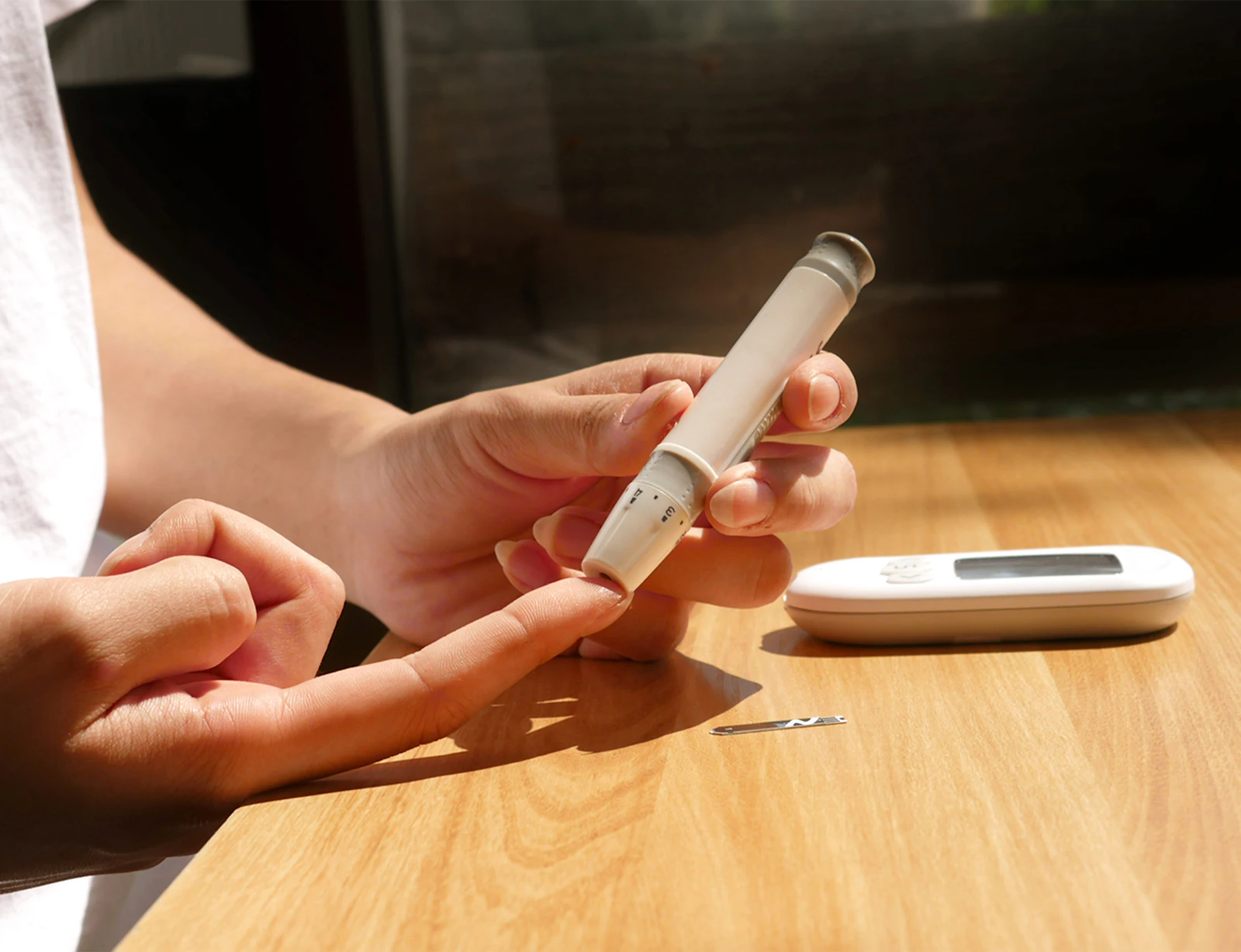
If you have been prescribed a GLP-1 medicine and are searching “weight loss pen how to use”, the most important rule comes first: follow the training your doctor or nurse gives you and the patient leaflet that comes with your specific pen. Pens differ between products, so this guide explains the general principles rather than replacing your own instructions. It also covers something leaflets cannot: how to keep your medicine safe in Bangkok’s heat.
This article is for patients who already have a prescription from a licensed doctor. If you are still deciding whether treatment is right for you, start with what is a weight-loss pen?
Before your first dose: doctor training
Your first injection should never be a guess. Before you start, your doctor or nurse should:
- explain which medicine you have been prescribed, by its generic name, for example semaglutide or tirzepatide;
- show you the pen, how to prepare it, how to set or check the dose and how to inject;
- watch you do your first injection, or do it with you, so you feel confident;
- explain the dose schedule, including when the doctor will review and possibly increase it;
- tell you which side effects are expected and which need urgent attention;
- give you clear written instructions in a language you are comfortable with.
Your doctor will set your dose. Doses start low and are increased gradually. Never change, skip, double or split doses yourself, and never try to adapt a pen to deliver an amount it was not designed for. If you are unsure about anything, ask before you inject. You can see how training fits into the wider process on our how it works page.
For medicine-specific background, see our guides to tirzepatide (Mounjaro) in Thailand and semaglutide (Ozempic and Wegovy) in Thailand.
Weight loss pen how to use: step-by-step injection basics (per leaflet)
The exact steps depend on your pen. Some are single-use auto-injectors, others hold several doses and need a new needle each time. The outline below reflects the general principles found in patient leaflets. Always follow your own leaflet where it differs.
- Check the pen. Confirm it is the medicine and strength your doctor prescribed, that it is within its expiry date and that it has been stored correctly. Look at the liquid through the window: it should usually be clear. Do not use it if it looks cloudy, discoloured or contains particles, or if the pen has been frozen or damaged.
- Wash your hands and gather what you need: the pen, a new needle if your pen uses one, an alcohol swab if your leaflet recommends it, and a sharps container.
- Choose an injection site. These medicines are injected subcutaneously, meaning into the fatty layer just under the skin, usually in the abdomen (avoiding the area around the navel), the front of the thigh or the upper arm, as your trainer showed you.
- Prepare the pen as your leaflet describes. For needle-type pens this includes attaching a new needle and any first-use check the leaflet requires.
- Inject as trained, holding the pen in place for the time your leaflet states so that the full dose is delivered.
- Remove and dispose. Take the pen away from the skin, then dispose of the needle or single-use pen safely (see below). Replace the cap on multi-dose pens.
- Record it. Note the date, and the site you used, in a diary or phone app. This helps with site rotation and with your weekly or daily routine.
Rotate your injection sites
Use a different spot each time, even if you stay within the same body area. Rotating helps prevent lumps, soreness or changes in the skin. Avoid skin that is bruised, tender, scarred or irritated.
If you miss a dose
What to do depends on the medicine and how much time has passed. Check your leaflet and contact your doctor if you are unsure. Do not take two doses close together to “catch up”.
Storing pens in a hot climate and when travelling
GLP-1 medicines are proteins that can be damaged by heat, freezing and strong light. In a city where outdoor temperatures are often high and parked cars become extremely hot, storage deserves real attention.
General storage principles
- Unused pens: keep them in the refrigerator at 2–8°C, in their original packaging to protect them from light.
- Never freeze. Keep pens away from the freezer compartment and the coldest back wall of the fridge. A pen that has been frozen should not be used, even after it thaws.
- Protect from heat and sunlight. Do not leave pens on a windowsill, in direct sun or near a stove.
- The in-use allowance differs by product. Some pens may be kept at room temperature for a limited period once in use, and the permitted temperature and duration vary between products. Follow your own leaflet exactly; do not assume what applies to one pen applies to another.
Bangkok-specific tips
- Never leave a pen in a car, even briefly. The inside of a parked car in Bangkok can become far hotter than any leaflet allows.
- Use an insulated cool bag when carrying a pen around the city, for example to the office or a weekend trip. Cool packs should not touch the pen directly, to avoid freezing it.
- Be aware of power cuts. If your fridge has been off for some time, check your leaflet and ask your clinic whether the pen can still be used.
- In shared or serviced apartments, keep pens in a clearly labelled box where others will not move them into the freezer.
When travelling
- Carry pens in your hand luggage, never in checked baggage, where they may be exposed to freezing temperatures.
- Bring your prescription and a doctor’s letter, and check the medicine rules of your destination before you leave.
- Pack an insulated travel case and plan for refrigeration at your hotel. Ask your doctor in advance how to manage dose timing across time zones.
How long does a weight-loss pen last? (depends on your prescribed dose)
Patients often ask how long a weight-loss pen lasts. The honest answer is that it depends on the product and on the dose your doctor has prescribed. Some pens are designed for a single injection, others for several doses at a set strength, and the number of doses per pen varies between products and strengths.
Two other limits also apply: the expiry date on the pack, and the in-use period stated in your leaflet once a pen has been started. Whichever comes first applies.
Please do not try to make a pen last longer by taking smaller amounts, or to use any medicine left in a pen beyond its labelled doses. Pens are designed to deliver specific, measured doses, and improvising can mean taking too much or too little. If you are worried about running out, especially before travelling, contact your clinic early so your doctor can plan your next prescription.
Weight loss pen needles and safe disposal
Needles
If your pen uses separate needles, use a new needle for every injection. Reusing needles makes them blunt, increases the risk of infection and can block the needle so you do not receive the full dose. Remove the needle after each injection rather than storing the pen with it attached, unless your leaflet says otherwise. Use only the needle type your leaflet or clinic recommends.
Never share a pen with anyone, even if the needle is changed. Sharing pens can spread blood-borne infections.
Safe disposal
- Place used needles and single-use pens straight into a sharps container, a rigid, puncture-proof box with a lid.
- Do not put loose needles into household rubbish or recycling, where they can injure cleaners and waste workers.
- Ask your clinic how to dispose of a full sharps container; many clinics and hospitals accept them.
- Keep pens, needles and sharps containers out of reach of children and pets.
When to contact your doctor
Mild nausea, a little bloating or a small amount of redness at the injection site are common, especially in the early weeks or after a dose increase. Our guide to weight-loss pen side effects covers how to manage them. Contact your doctor if:
- side effects are not settling or are affecting your daily life;
- you have missed a dose and are unsure what to do;
- a pen may have been frozen, overheated or damaged, or the liquid looks abnormal;
- you think you may have injected the wrong dose;
- you have redness, swelling or pain at an injection site that is getting worse;
- you are planning a pregnancy, become pregnant or start a new medicine.
Seek urgent medical care if you have severe or persistent abdominal pain, vomiting you cannot stop, signs of dehydration, or signs of an allergic reaction such as swelling of the face or throat, a widespread rash or difficulty breathing.
Frequently asked questions
How long does a weight-loss pen last?
It depends on the product and your prescribed dose. Some pens hold a single dose and others several, and each also has an expiry date and an in-use period in its leaflet. Your doctor will plan your prescriptions so you do not run out.
Do I need a new needle every time?
If your pen uses separate needles, yes: use a new needle for each injection and dispose of it in a sharps container. Some pens are single-use auto-injectors with a built-in needle. Your leaflet and trainer will explain which type you have.
Can I keep my pen out of the fridge in Bangkok?
Unused pens belong in the fridge at 2–8°C. Some products allow a limited period at room temperature once in use, but the limits differ, and Bangkok temperatures can exceed them. Follow your leaflet and use a cool bag when you are out.
Does the injection hurt?
Most people find it causes little discomfort because the needle is very fine and the injection goes just under the skin. Letting the alcohol dry, if you use a swab, and rotating sites can help. Ask your trainer if you feel anxious.
Have questions? Get injection training from our team on WhatsApp — in English or Thai.
This article is general information and not medical advice. Prescription medicines are only provided after an assessment by a licensed physician, where clinically appropriate. Individual results vary.